

What is allocation of credit and why does it matter?
Allocation of credit demonstrates the contribution of the senior personnel for a specific project. It must equal 100% across all Key Personnel entered into the Cayuse personnel section and be represented as whole numbers only (no decimals). Otherwise, The Office of Sponsored Programs will allocate the credit equally across the lead principal investigator and co-investigators. It is important because the indirect costs return will be distributed per the allocation of credit entered. Additionally, it determines how much credit departments and Academic Units are given for the proposal and subsequent award.
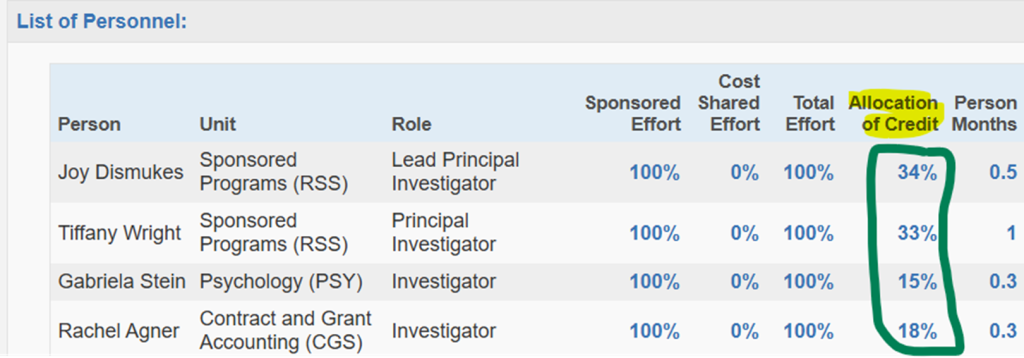
Thus, it is important to have a reasonable discussion of this at the time of submission and Cayuse creation about how to split the allocation of credit if working with a team. Generally it is advisable that all investigators/key personnel get some amount of credit and that it be approximate and proportional to the time commitment or the role on the proposed project. Other considerations may include departmental and/or investigator/lab resources that will be devoted to the project and may incur expenses not covered in the grant budget (e.g., service/maintenance fees, upgrades, cleaning, renovations, etc). Please see this excel template for an example of how to consider the time commitment (person-months) of investigators over the course of the grant.
- Indirect costs are distributed to PI (10%), department (10%) and UNCG/DORE (80%).
- Example: $1,000,000 NIH grant. UNCG will get 47% percent, or up to $470,000 in Facilities and Administrative Costs, also known as Indirects (ICR = indirect cost recovery), over the course of the grant. 10% ($47,000) of that will go to department(s) and 10% ($47,000) to faculty investigators based on allocation of credit. If there are 2 investigators in separate departments and they indicated 50% credit in Cayuse for each, each PI would get ½ or $23,500 and each department would get $23,500. The school would get credit for receiving the full $1 million dollar grant, and each department would get credit for ½ of the grant or $500,000 each. Imagine the many iterations on this depending on size of team, range of departments and schools involved, and how they decide to split the credit. This choice has real ramifications for PIs, departments, and the school so it is important to be well-informed.
- Faculty and department portions of indirects are paid out at the end of the following fiscal year based on the grant funds expended the prior year, not on the amount awarded. In other words, if you were awarded $100,000 one year, but only spent $75,000 that year, you would receive a deposit the following year based on 10% of 47% of $75,000. This would occur for each year of the grant.

Sources and additional references:
Above was adapted and expanded on from materials provided by Dr. Esther M. Leerkes (Associate Dean for Research in HHS)
CGA Policy on Facilities & Administrative (F&A) Costs on Sponsored Awards